
Huttonsville Prison Release Paths
Huttonsville is a West Virginia state correctional institution, not Randolph County’s local jail. A person who physically leaves may enter the community on parole, conditional release, or mandatory post-release supervision. A final discharge means the controlling sentence or supervision term has ended. Those outcomes are not interchangeable. The West Virginia Division of Corrections and Rehabilitation, or WVDCR, holds the institutional release transaction, the offender time sheet, and any discharge certificate it created.
Departure can also be a transfer. Movement between the Work Camp and the main correctional center, or from Huttonsville to another WVDCR facility, keeps the person incarcerated. A transfer to another sovereign likewise ends Huttonsville’s physical custody without proving community release. The receiving institution or agency belongs in the destination field of the release or transfer record. Ask for that field when the public search no longer shows the expected location.
A missing Huttonsville result does not by itself prove release; match the WVDCR transaction to the receiving facility, parole order, or discharge record.
Confirm a Huttonsville Release
The official WVDCR offender-search hub separates prison records from regional-jail records. Choose the prison search for a person held at Huttonsville. The live result fields were blocked during research, so do not assume that every public detail displays a released label, an actual date, or a supervision office. Save the exact terms and date shown rather than translating them into a stronger claim.
- Open the WVDCR hub and select the state-prison search. Compare full identity information, not only a similar name.
- Check VINELink under West Virginia for the same person and agency. Treat a status alert as a timely lead.
- If parole is involved, obtain the individual written decision from the West Virginia Parole Board. A calendar entry only proves a hearing was set.
- Ask WVDCR for the actual release transaction, discharge certificate, and relevant time sheet. Request the destination if the event may have been a transfer.
- Contact the assigned parole office after community release when supervision must be confirmed. The Elkins office serves Randolph County but may not be the assigned office in every case.
Two records usually provide a clearer answer than a single screen. The institutional transaction proves what Huttonsville recorded, while the parole, conditional-release, or discharge order identifies the legal authority. The Randolph County released-inmate search path explains how these sources differ from a live roster.
Note: VINE is a notification feed, not a certified release archive, so confirm its event with the record held by WVDCR.
Huttonsville Release Records Contact
Questions about a person’s location, approved contact method, or institutional record should go to the facility or the WVDCR custodian. Give a full name, date of birth, offender number if known, and a narrow date range. Ask for a specific record series rather than “all records.” West Virginia FOIA permits electronic copies and requires a response as practicable within five days, excluding weekends and legal holidays, though exemptions or redactions may apply.
Huttonsville Correctional Center and Jail
109 HCC Boulevard
Huttonsville, WV 26273
Phone: 304-335-2291
Fax: 304-335-4256
Agency: West Virginia Division of Corrections and Rehabilitation
A focused request may seek the actual departure date, release or transfer type, legal authority, receiving agency, discharge certificate, and releasable time-sheet fields. When parole is central, the Board can be reached at 1409 Greenbrier Street, second floor, Charleston, WV 25311, or 304-558-6366. DCR Records handles the institutional computation; the sentencing Circuit Clerk addresses an error alleged in the court’s order.
Classify Huttonsville Custody First
Randolph County contains two state-run facilities that serve different populations. Tygart Valley is the regional-jail channel for most Randolph arrests and short-term detention. Huttonsville houses state prisoners and includes an adjacent lower-security Work Camp. Geography does not pick the correct database. The legal custody type does.
The distinction changes every later step. A Randolph defendant at Tygart Valley is checked through the current RJA jail system, the criminal case, and the regional-jail transaction. A sentenced prisoner at Huttonsville belongs in the WVDCR prison search, sentence computation, and state release record. Treating the two as one county roster can turn a prison transfer into a false release claim.
The official Huttonsville facility page identifies the center and Work Camp. The captured page below provides a visual reference to that official source.
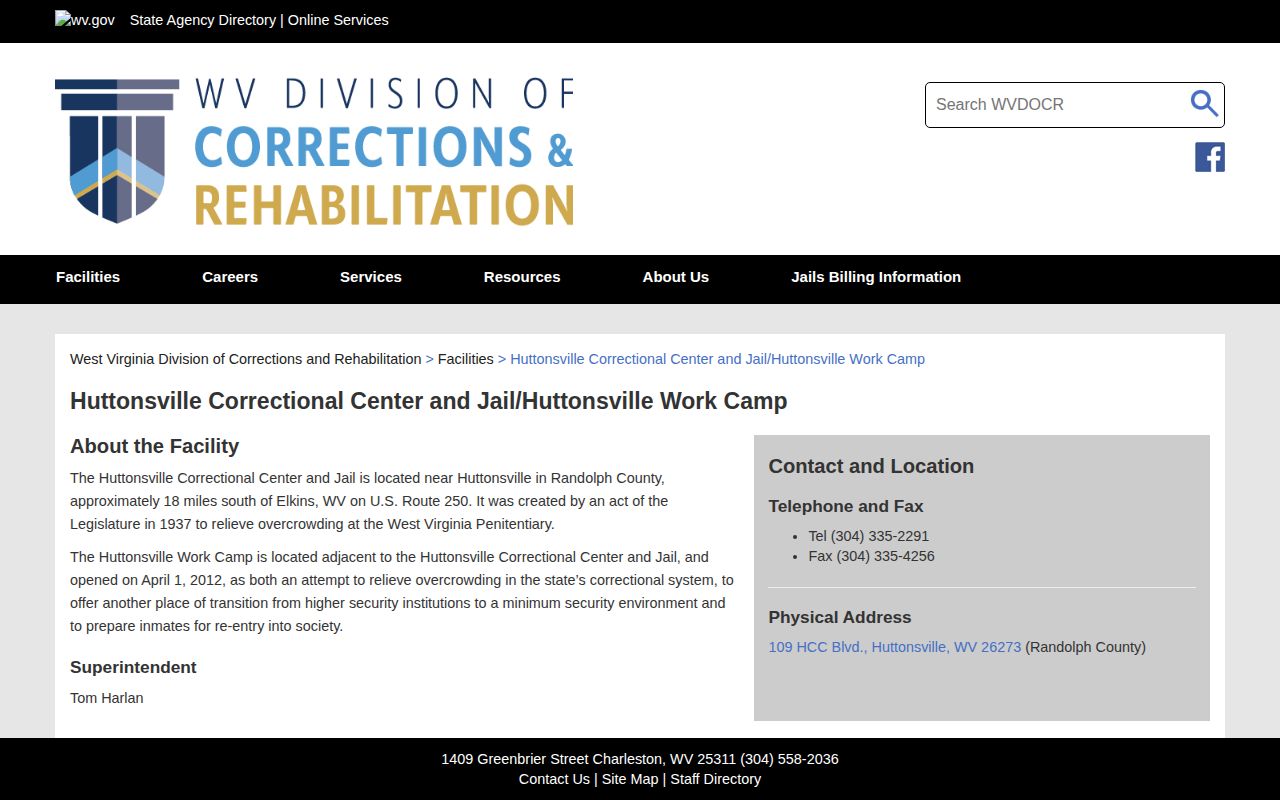
The facility page confirms which institution and contact the search concerns, but it does not replace an individual offender record or actual release transaction.
Huttonsville Custody Has Two Settings
Huttonsville’s local history is part of why its records are easy to misread. The correctional center traces to a 1937 legislative act. The Work Camp opened on April 1, 2012 as a lower-security transition setting. Both sit in Randolph County, about eighteen miles south of Elkins, yet their inmates remain part of the statewide prison system.
A move to or from the Work Camp is not proof that a sentence ended. It may reflect a change in security level or institutional placement. The WVDCR transfer record should name the movement. If a later community release occurs, ask for the separate transaction and its authority. Keeping those events separate prevents a location change from being described as discharge.
Read Huttonsville Release Dates Carefully
WVDCR uses specific terms for future prison dates. A minimum discharge or final release date, often called MDD, is the scheduled end point under the current sentence computation, continuous incarceration, and existing good-time record. A parole eligibility date, or PED, is only the date when a person may be considered for parole. Neither proves that the person walked out of Huttonsville.
| Record term | What it establishes | What it does not prove |
|---|---|---|
| PED | Eligibility for parole consideration | A grant or physical release |
| MDD or final release date | Current WVDCR sentence calculation | Actual departure on that date |
| Release transaction | Recorded institutional departure and type | End of later supervision unless stated |
| Discharge certificate | Final discharge recorded by WVDCR | Earlier prison-exit time when parole came first |
Good-time loss or restoration, jail credit, consecutive sentences, a corrected order, an escape, a detainer, or a required release plan can change the time sheet. West Virginia law uses a one-for-one framework for eligible incarcerated days, not a general rule that every person serves eighty-five percent. The authoritative answer is the case-specific WVDCR time sheet.
Huttonsville Parole Versus Discharge
Parole allows a person to leave prison under community supervision while the sentence continues. Conditional release and mandatory post-release supervision also place someone outside the institution under WVDCR authority. Final discharge is later and ends the relevant state correctional term. Use “released to supervision” when that is what the record shows.
- Parole
- Community release approved by the Parole Board, followed by WVDCR supervision.
- Mandatory supervision
- A statutory period of monitored release that can replace part of accumulated good time for specified cases.
- Detainer
- A hold or request from another authority that can prevent community release or cause transfer.
- Final discharge
- The recorded end of the sentence or supervision term under the controlling authority.
After a parole departure, the assigned office can corroborate active supervision. The Elkins Parole Office is at 1513 Harrison Avenue, Unit 27, Elkins, WV 26241, and its phone is 304-637-0379. It is a routing contact, not a public name-search database. A person may also be assigned elsewhere based on the approved release plan.
Strong Huttonsville Release Proof
A past court sentence, a news report, or an old photograph does not establish present status. Start with the strongest source that matches the question. For physical departure, seek the actual WVDCR transaction. For parole authority, request the written Board decision. For the later end of supervision, request the discharge record. A court order explains the sentence but may not contain the exact institutional exit time.
Preserve the date checked and the exact agency wording. If the sources conflict, rank the signed order or release transaction above a search snippet, roster absence, social post, or news account. When the destination remains unclear, describe the release as unconfirmed and ask WVDCR whether custody ended, shifted to supervision, or moved to another institution.
Ask each custodian for the record it actually owns. WVDCR Records can provide the time sheet, releasable OIS fields, discharge certificate, and institutional release transaction. The Parole Board holds the written parole result, while the assigned Parole Services office holds supervision information after release. The sentencing Circuit Clerk keeps the judgment and any corrected order, but may not know the exact hour the person left Huttonsville. Splitting the inquiry this way also helps distinguish the date prison custody ended from the later date parole or mandatory supervision ended.
Note: A released Huttonsville prisoner may remain on parole or mandatory supervision even though the person is no longer inside the institution.