
Randolph Projected Versus Actual Release
WVDCR policies call the administrative forecast the minimum discharge/final release date, often shortened to MDD. It assumes continuous incarceration under the current sentence calculation and no later loss of good time. The Parole Board uses parole eligibility date, or PED, for the date a person may be considered for parole. PED is not a grant. MDD is not a record of physical departure.
A Randolph County release can also mean several distinct things. A person may leave Tygart Valley on bond, under a dismissal or time-served order, or as a transfer to another agency. A state prisoner may leave Huttonsville on parole, conditional release, mandatory supervision, or final discharge. Only the actual release or transfer transaction shows what occurred at the facility. A later discharge certificate may prove the sentence itself ended.
Pretrial detention follows a different clock. A court may set or change bond, dismiss a charge, or enter another order, but no prison good-time formula fixes the exit date. Facility processing and any other hold still must clear. The order and Tygart Valley transaction should be read together.
Find Randolph Projected Release Dates
Begin with custody type. A Randolph pretrial or short-sentence detainee normally uses the regional-jail channel. A state prisoner, including a person at Huttonsville, uses the prison channel. The public DCR search fields could not be fully verified during research, so do not assume the live result always exposes MDD, PED, a release status, or a supervising office. Quote the exact label only when it is visible.
- Open the WVDCR offender-search hub and choose Jails for Tygart Valley or Prisons for a state sentence.
- Match identity details, not just a name. Save the time checked, facility, and exact field labels shown.
- If a future date is visible, determine whether the portal calls it MDD, final release, PED, or another term. Do not rename it.
- For a full calculation, request the DCR time sheet and releasable OIS fields. Ask for the actual release transaction after the forecast date passes.
- Obtain the sentencing order and certified jail credit from the appropriate Randolph clerk when a court input appears wrong.
- Check VINE, the Board record when parole applies, and any detainer or receiving-agency record before treating the date as community release.
DCR Records is the source for time-sheet, good-time, jail-credit, MDD, and PED questions. Research identified the Records contact at 1409 Greenbrier Street, Charleston, WV 25311, and 304-558-2036, but personnel details should be rechecked before relying on a named staff member. The Randolph County released-inmate home page explains the broader release-record request path.
A focused request should seek the current time sheet, sentence entries, court-certified jail credit, good-time changes, PED, MDD or final-release label, and releasable OIS fields. If the date has passed, request the actual release transaction and discharge certificate as separate records. West Virginia FOIA permits a request to the record custodian with reasonable specificity. It generally requires production, an inspection arrangement, or a written denial within a maximum of five days, excluding weekends and legal holidays, as practicable.
Note: A public search field is a lead unless its label and current value can be tied to the correct person.
Randolph Release Time-Sheet Calculation
The court supplies the sentence and certifies presentence confinement credit under §61-11-24. DCR then calculates the administrative date. A plain sequence is: begin with the fixed maximum or aggregated maximum, apply court-certified jail credit, apply statutory good time for eligible days in physical custody, account for credit lost or restored, apply any extra approved credit and offense-specific rules, then issue or revise the time sheet.
Under West Virginia Code §15A-4-17, an eligible adult in DCR custody earns one day of good time for each day physically incarcerated. Presentence jail days credited by the court can count. No good time accrues while on parole, bond, or another non-incarcerated status. Life sentences receive none, and consecutive sentences are combined for the calculation. Eligible felony inmates may also receive limited credit, including up to ninety days for an approved optional academic or vocational program.
Discipline can cause loss of some or all good time. The superintendent, with commissioner approval, may restore it. DCR revises the statement when loss, restoration, court credit, or another approved adjustment changes the earliest discharge. That is why an old time sheet should not be treated as current.
The official statute capture shows the controlling one-for-one credit framework. Review the current good-time statute when checking a Randolph County calculation.
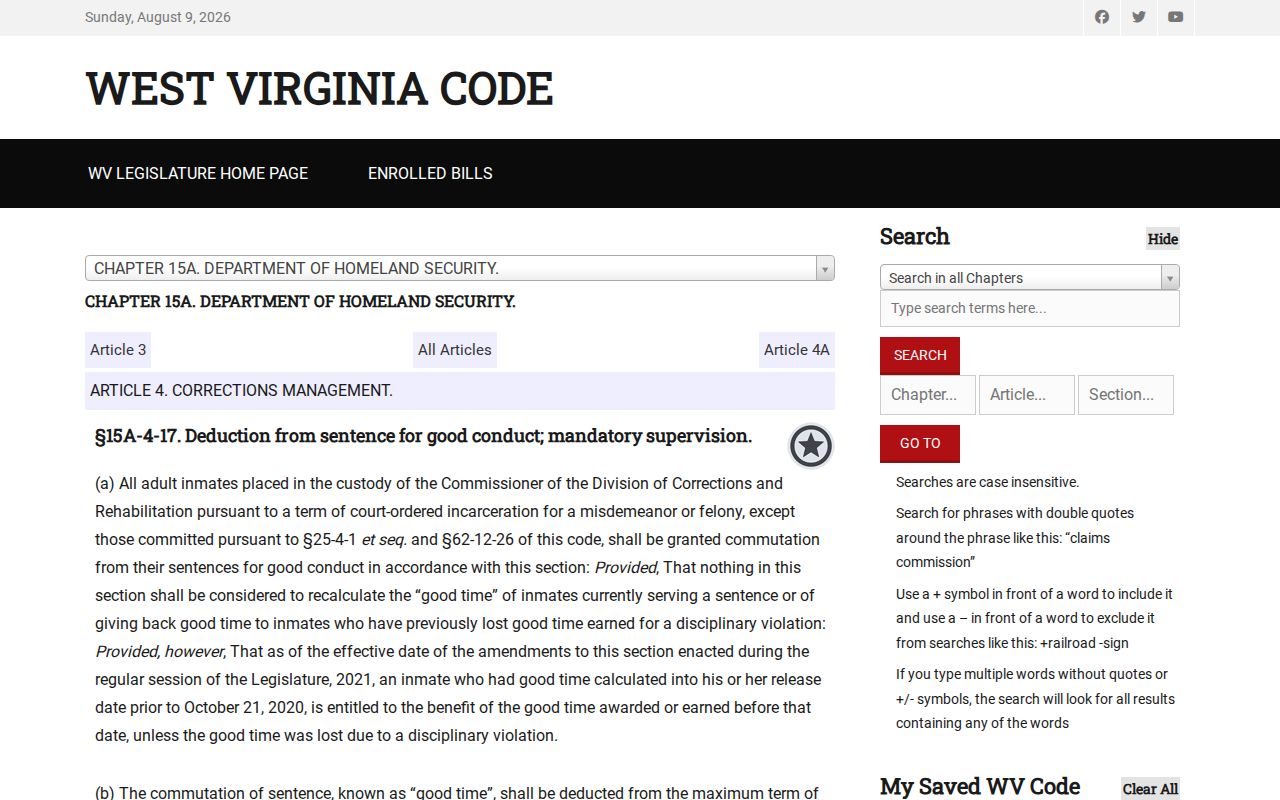
The statute also explains why credit, confinement status, and mandatory supervision must be separated in any projected date.
Why Randolph Release Dates Change
A projected release date is built from facts that can move. Some changes alter the arithmetic. Others prevent community release even when the sentence calculation reaches its current endpoint. The record should identify which kind of change occurred.
| Factor | Effect on the date or release | Best source |
|---|---|---|
| Good-time loss or restoration | Moves the minimum discharge calculation | Current DCR time sheet |
| Presentence credit correction | Changes credited confinement days | Court order and revised DCR sheet |
| Consecutive sentences | Aggregates maximum terms for calculation | Sentencing order and DCR computation |
| Parole decision | May authorize an earlier supervised exit but not same-day departure | Board decision and DCR transaction |
| Detainer or new hold | May send the person to another authority instead of the community | Release destination and receiving agency |
| Transfer | Changes facility, not custody status | DCR transfer record |
| Release-plan requirement | Can delay physical exit after eligibility or a contingent decision | Board or DCR record |
An escape, new sentence, court correction, or offense-specific restriction can also affect the result. Do not calculate a case by subtracting days from a sentence without the current official inputs. DCR's case-specific time sheet remains the authoritative administrative calculation.
Parole eligibility needs special care. Under §62-12-13, the baseline is the minimum indeterminate term or one-fourth of a definite sentence, subject to the statute's requirements and exclusions. Firearm and robbery findings, life terms, offense date, prior felonies, disciplinary status, programming, safety findings, and an approved home plan can affect consideration. Section 62-12-13a states that eligibility does not confer a right to release.
A Board grant also may not produce an immediate exit from Tygart Valley. For a regional-jail parole grant, the Board says the person must transfer to a DCR institution for intake and fingerprinting and advises anticipating seven to ten days. The hearing decision, the transfer, and the later community release should therefore have separate dates in the verification record.
Confirm Randolph Actual Release
When a forecast date arrives, check the correct live custody system and VINE. A VINE alert is useful for timely notice, but it is not a certified discharge record. Request the actual DCR release transaction, legal authority, release type, and destination. If parole applies, pair it with the written Board decision and the assigned parole office. The Randolph County VINELink inmate search explains how to register for custody-change notice.
For Tygart Valley, ask whether the person returned to the community or transferred to Huttonsville, another jail, ICE, or federal custody. For Huttonsville, distinguish parole or mandatory supervision from final discharge. For a pretrial federal detainee, the federal docket and USMS record may be needed. BOP and ICE each have separate locators and scope limits.
A BOP result may show a past Release Date and a RELEASED location for a covered federal sentence, but BOP warns that supervision or another justice system's custody may continue. ICE ODLS covers current ICE custody and some people released from ICE within the prior sixty days. Neither result changes a WVDCR date, and neither can be used to fill a gap in a Randolph County state time sheet.
For an ICE or federal pickup from Tygart Valley, request the release or transfer destination from DCR. The date Tygart Valley's custody ended may be the date another authority took control. It is not a community-release date. For federal pretrial custody, the federal docket and a focused USMS request are the proper sources because USMS has no public person-by-person release locator.
The strongest proof ranks above search absence. Use the signed order or actual transaction first, then the current agency result, VINE alert, calendar, or other lead. If sources conflict, describe the release as unconfirmed until the custodian resolves it.
Note: A roster absence proves neither community release nor completion of every sentence and supervision term.
Randolph One-for-One Good Time
West Virginia does not use a general rule that all prisoners must serve eighty-five percent of a term. The controlling provision uses one-for-one good time for eligible days in physical custody, subject to exclusions, sentence structure, discipline, credited time, and offense-specific law. Importing another state's percentage would produce a false Randolph County projected release date.
Section 15A-4-17 adds another crucial distinction for specified felonies committed on or after July 1, 2013. For violence against a person, a minor-victim offense, or firearm use covered by the statute, one year of accumulated good time converts to a year of mandatory post-release supervision when calculated discharge is reached. Electronic or GPS monitoring applies. For other felonies, a court may order up to one hundred eighty days of post-release mandatory supervision.
As a result, physical prison exit can occur before final legal discharge from DCR supervision. The correct description is release to mandatory supervision, not sentence completion. Ask for both the actual release transaction and the later discharge record when both dates matter.
County-jail bond release does not use this prison good-time computation. Bond authority comes from the court, followed by facility processing and a check for other holds. A regional-jail sentence may involve jail credit and a DCR calculation, but the controlling sentence and commitment must be confirmed before applying §15A-4-17. Never assume every Tygart Valley departure follows the Huttonsville prison-release framework.
A final discharge certificate answers a later question than the projected date. DCR policy recognizes discharge certificates for convicted felons, while conditional-release policy governs a supervised exit under continuing authority. Request the record whose legal event matters instead of asking for a generic date that could refer to eligibility, scheduled discharge, physical departure, or the end of supervision.